
Missing information?
Do you have any additional information you would like to share about a soldier?
Submit- Full
name
BANGS, Francis Nathan Jr - Date of
birth
17 January 1922 -
Age
22 -
Place of birth
New York -
Hometown
Manhattan, New York County, New York City, New York
Personal info
Military service
- Service
number
O-1011531 -
Rank
First Lieutenant -
Function
Communications Officer -
Unit
703rd Tank Destroyer Battalion,
Communication Platoon
-
Awards
unknown
Death
-
Status
Died non-Battle - Date of
death
18 December 1944 - Place of
death
unknown
Grave
-
Cemetery
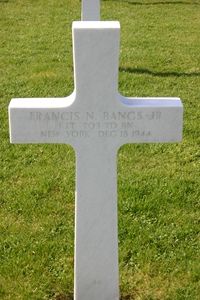
American War Cemetery Henri-Chapelle
| Plot | Row | Grave |
|---|---|---|
| H | 15 | 46 |
Immediate family
-
Members
Francis N. Bangs (father)
Catherine C. (Clement) Bangs (mother)
Whitney W. Bangs (brother)
Catherine F. Bangs (sister)
More information
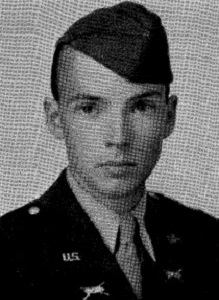
1st Lt Francis N. Bangs Jr. attended St. Paul's High School with the class of 1940 and was an actor.He joined the Natiional Guard on 27 Janaury 1941 in New York City, New York and was selected for the Officers' Candidate School at Fort Knox. He was sent overseas in August 1943.
After his death, his Commanding Officer wrote: "Many have been the times during the recent long winter evenings when we would gather in some room and argue late over some subject far away from us: postwar plans, China, Russia etc. Few could match his mental alertness or his wide variety of interests."
Four years before, when it was the German armies that were over-running Belgium and France, Bangs, eighteen years old, was a Sixth Former at the School. He was a supervisor in a Fourth Form house, an officer of the Rifle Club, the Radio Club and the Dramatic Club; he took part in the Cadmean-Concordian joint debate and in May, 1940, while many of his countrymen still cherished the false hope of peace, he wrote in the Horae: "In the early months of the war, we could justifiably maintain that the traditional preponderance of power lay with the Allies, and therefore, logically, our intervention was not needed. Tradition has given way to the might of misapplied science. The Danish and Norwegian invasions have been but lately concluded: at this moment, 'total war' is raging in Belgium and Holland, - too soon, possibly in all France itself. . . . The question now is: Must we try to tip the scales of victory, or are we prepared to risk facing the future alone? . . . Let us consider the facts calmly and openly. . . . I have made no mention of suffering humanity, of ruined civilization and burning cities, nor of our great moral responsibility. . . . I feel we should intervene at once before it is too late . . . ammunition, tanks, trucks and planes should be sent to the limit of our ability, I believe, and, if it is vital to ensure our own protection, men as well." The most significant thing about Bang's intelligent argument was the emotion that underlay it. At the end of a dispassionate refutation of the claim that it would be expedient for America to leave the victims of aggression to their fate, he can no longer wholly conceal his pity and his indignation, pity for the oppressed, indignation that there should be any argument at all. Clearly, before the fall of France he aready knew that America should make war. Equally clearly, he himself was already prepared to fight on foreign soil, not for his country's protection only, but for its honor, which for him resided in response to obligation entailed by wealth and power.
His brother, Whitney Waldo Bangs, died in a POW camp in Germany on 5 March 1945 and is buried next to him.
Source of information: Peter Schouteten, www.wwiimemorial.com, www.archives.gov, www.ancestry.com - 1930 Census / U.S., Headstone and Interment Records for U.S. Military Cemeteries on Foreign Soil, St. Paul's School War Book
Photo source: Peter Schouteten, St. Paul's School War Book